
learn german
How to Write a Formal German Email (with Examples)
The structure, phrases and exam tips for a formal email in German, with three graphics and a model email you can copy the pattern from.
October 18, 2026 · 7 min read
✉️ Why the format matters
A formal email in German is more than polite words. Readers expect a clear structure: a subject line, the right greeting, a short reason for writing, your points in order, a closing sentence and a formal sign-off. In the Goethe-Zertifikat B1 writing section, the formal email is a short task, so every part of the structure counts. Always check the official exam information for the exact tasks and marking criteria.
The anatomy of a formal email
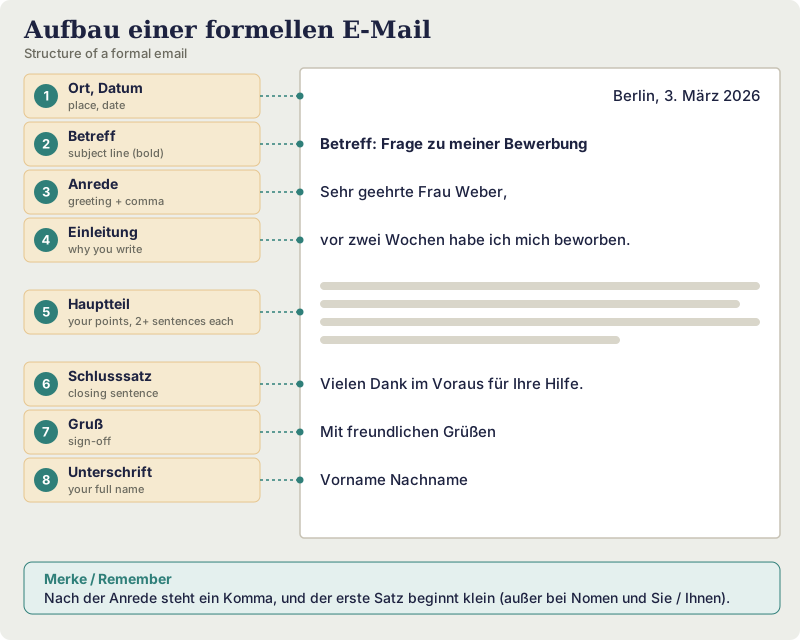
Here is what each part does:
- Ort, Datum: in a printed letter, the place and date go at the top right. In an email the date is added automatically, so you can skip it.
- Betreff: the subject line. Keep it short and clear, for example: Frage zu meiner Bewerbung.
- Anrede: the greeting, for example: Sehr geehrte Frau Weber, / Sehr geehrter Herr Weber, / Sehr geehrte Damen und Herren,
- Einleitung: one sentence that says why you are writing.
- Hauptteil: your points, one after another, with at least two sentences each.
- Schlusssatz: a polite closing sentence, for example: Vielen Dank im Voraus für Ihre Hilfe.
- Gruß: Mit freundlichen Grüßen
- Unterschrift: your first and last name.
Remember: after the greeting comes a comma, and the first sentence starts with a small letter (unless the first word is a noun or a form of Sie).
Greetings and openings
Choose the greeting by how well you know the person:
Sehr geehrte Frau Schneider, / Sehr geehrter Herr Schneider, → a named person you don't know well, or someone senior.
Sehr geehrte Damen und Herren, → you don't know who will read your message.
Liebe Frau Schneider, / Lieber Herr Schneider, → a colleague you know well but still address with Sie.
Opening sentences you can reuse:
vielen Dank für Ihre E-Mail vom 2. Februar.
ich schreibe Ihnen, weil ich eine Frage zu … habe.
ich beziehe mich auf Ihre Nachricht von gestern.
leider muss ich Ihnen mitteilen, dass …
Polite requests with Konjunktiv II
Formal German uses Konjunktiv II to sound polite. These three patterns cover most situations:
Könnten Sie mir bitte mitteilen, ob …?
Wäre es möglich, …?
Ich wäre Ihnen dankbar, wenn Sie … könnten.
Compare the informal and the formal version: Kannst du mir helfen? → Könnten Sie mir bitte helfen?
Closing sentence and sign-off
Closing sentences: Ich freue mich auf Ihre Antwort. / Vielen Dank im Voraus für Ihre Hilfe. / Für Rückfragen stehe ich gern zur Verfügung.
Formal sign-offs: Mit freundlichen Grüßen / Freundliche Grüße. Write your full name on the next line.
For friends, use the personal style instead: Viele Grüße, Liebe Grüße or Bis bald, followed by just your first name.
Personal or formal?
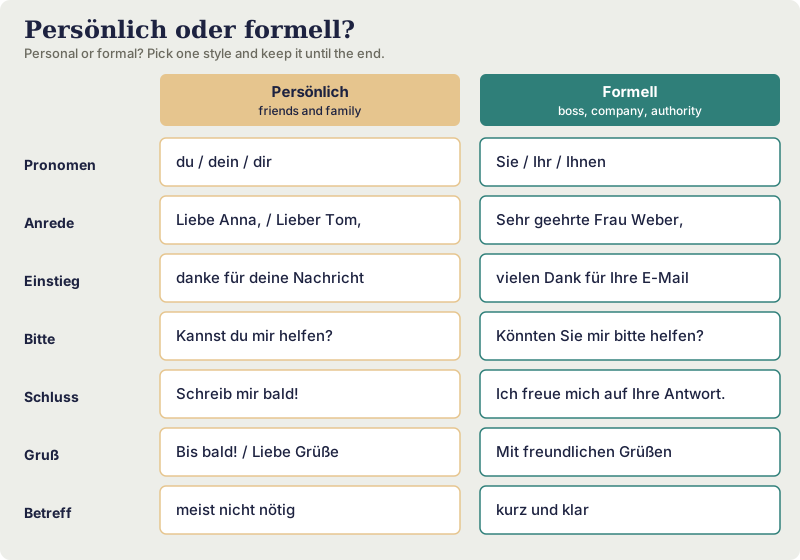
The most common mistake is mixing the two styles, for example starting with Sehr geehrte Frau Weber and then writing du. Pick one style and keep it until the end.
A model email, step by step
Task: You applied for an internship at a company. Ask Frau Weber whether your documents arrived, and ask when you can expect an answer.
Betreff: Frage zu meiner Bewerbung
Sehr geehrte Frau Weber,
vor zwei Wochen habe ich mich bei Ihrer Firma für ein Praktikum beworben. Könnten Sie mir bitte mitteilen, ob meine Unterlagen angekommen sind? Außerdem wäre ich Ihnen dankbar, wenn Sie mir sagen könnten, wann ich mit einer Antwort rechnen kann.
Vielen Dank im Voraus für Ihre Hilfe.
Mit freundlichen Grüßen
Vorname Nachname
This email covers both points, uses Konjunktiv II to stay polite, and is about 50 words long.
How to approach the task
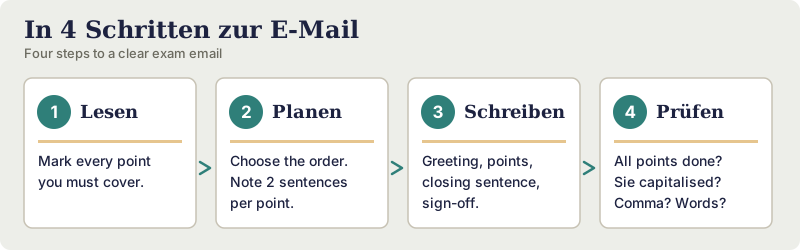
- Read the task and mark every point you have to cover.
- Decide the order. You don't have to follow the order of the task, but you must not forget a point.
- Write about two sentences for each point. Don't squeeze two points into one sentence, because it is easy to lose marks that way.
- Watch the length. The formal email in the B1 exam is short (around 40 words), so make every sentence useful. Check the current exam rules.
- Check at the end: every point covered? Sie, Ihnen and Ihr with a capital letter? A comma after the greeting? A closing sentence and a sign-off?
Common mistakes
- Writing du instead of Sie in a formal email.
- Starting the first sentence with a capital letter after the greeting comma. Write: Sehr geehrte Frau Weber, vielen Dank für …
- Forgetting the capital letters in Sie, Ihnen and Ihr.
- Starting with Hallo or Hi when you write to a company or an authority.
- Leaving out the subject line, or making it too long.
- Ending without a closing sentence or a sign-off.
Practice
Try the Schreiben tasks on the Mock tests page, then check your email against the lists above. Read your email once more as if you were the person receiving it: is it clear what you want?